Some mathematical interests
Numbers.1
Here's a the outline of a little talk I gave a while back about some relatives
of the Fibonacci numbers. To make a long story short, there are some pretty
curious properties associated with these peculiar numbers (all except for 23,
139, 211, 422, 461, and 761 of course!).
Numbers.2
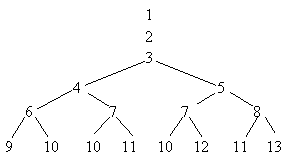
In the mid 1970's I contemplated the sequence of powers of 2 and 3, combined together and sorted:
(2,3,4,8,9,16,27,32,64,81,128,243,256,512,729,1024,...). I wondered whether the ordering of the sequence by bases (2 or 3) as follows: (2,3,2,2,3,2,3,2,2,3,2,3,2,2,3,2,2,3,2,...) would ever repeat or not. I asked a couple of mathematician friends about it and none seemed to know. I forgot about the question for a decade or so, but while at the University of Alaska I asked Ron Gatterdam about it. He was certain the sequence was irrational (non-repeating) and was confident he could prove it. The next day we both produced proofs that it was irrational. I then forgot about the problem for another 20 years.
Recently I started thinking about it again, and discovered some interesting properties and conjectures about these Ordered Exponential Sequences, and have been working up some of what I know. In the meantime, a colleague informed me about the Online Encyclopedia of Integer Sequences. The sequence has apparently been looked at as early as 1931. It even has a sequence number A006899.
Here's a little calculator for dealing with some properties of these Ordered Exponential Sequences.
Tiling
I've been looking into something I call the "tile number" of a graph.
Informally, the tile number is the smallest number of rigid polygons, out of which a given
planar graph can be constructed. That such a number exists is clear from the well-known
result that one can draw any planar graph using straight lines for edges. Some of the
non-deterministic tilings displayed here can be used to
show that many different graphs of the same size (nodes and lines) have tile number equal
to one. A companion inquiry concerns the construction of graphs out of fixed components. This particular piece of JavaScript allows you to
construct such graph tilings
quasi-randomly (here are a couple of related things: weaving
and wallpaper. One question I've played
with is this: what is the smallest tile number of a class of planar graphs
such that the 3-coloration of those graphs is NP-complete? If the number is
small, then we can randomly generate all interesting problems pretty easily.
Four-regular planar graphs
Some four-regular graphs can be traversed by a single "forward walk". For a
given planar embedding of the graph, we begin at any node n and construct a walk as
follows: choose p, any neighbor of n, as the next node. Consider the lines entering p:
orient each line into p in counterclockwise order, beginning with the line from n to p.
Label these lines "back," "right," "forward," and
"left." A forward walk consists of a walk which always chooses the forward line.
A tangle is a planar four-regular graph in which a single forward walk visits
every line. In my dissertation I showed that three-coloration of tangles was NP-complete. Tangles have
numerous other interesting properties: the dual is bipartite; each node appears in both
odd and even positions in the complete forward walk; the tangle number of a
three-connected graph is a graph-invariant, etc.
Approximating space with graphs
Perhaps the continuum is an illusion: a cognitive simplification of an ultimately discrete
universe. In a paper in Discrete Mathematics I investigate
the question of the smallest graph in which a given metric space can be modeled. Just as
one might inquire about the space of smallest dimension to model a given set of
proximities between objects, one might prefer the parsimony of assuming merely that space
is a graph. I suspect that physics gets interesting in graphs, since there is no
requirement that space be uniformly shaped.
Navigating in graphs
Are certain graphs intrinsically more navigable than others? That's what I'm
looking into most recently. In addition to looking at such things as graph
domination (analogs of beacons), and metric properties, I've also been looking
at "field effects" like gravity and magnetism in graphs. If a graph is
gravitationally flavorable, can we find our way around in it better. To
get started, I've built Grapher
which allows the building and editing of graphs. Try it out. A recent paper on the topic can be found here.
Generating random objects
Generating a random number is fairly easy (though people still work on the
problems of how best to do it with certain constraints on, for example,
security.) Suppose we wish to generate a random graph, or a random polygon, or a
collection of N colors that are maximally distinguishable by humans. How to
proceed with these more complex objects? If you have a browser that can open SVG
files, take a look at the approaches discussed here:
drawing
random polygons with JavaScript and SVG.
Calculating distances between objects
Distances between two points are easy to find. Suppose we wish to find distances
or similarities between two more complex things like two strings, or two graphs.
How might we do it? Here's a recent paper on the topic.
Non Platonic dice
While the Platonic solids all make for nice, and seemingly fair, dice, certain non
Platonic polyhedra are just as fair. For any n, we may easily construct a 2n
sided fair die by gluing together the bases of two pyramids. Each pyramid
consists of one regular n-gon as its base and n triangular sides. In two
dimensions the length of a side does not determine the probability of its
occurrence: just as important is the position of the center of gravity relative
to that side. Also, some dice allow probabilities of some sides to change
depending on the distance they are dropped.
Non-associative groupoids
Just about all of published mathematics discusses associative structures. But
not all things are associative. A black birdhouse is not equal to a blackbird
house, for example. So, concatenation of English morphemes is not associative
under English semantics. Other than its cognitive convenience, what makes a(bc)=(ab)c
any better than say a(bc)=(ca)b? In a census of small groupoids, I discovered
that associativity is neither the most nor least ubiquitous of principles. Its
ability to help prove theorems (in conjunction with, say, a left identity or a
right inverse) is also neither greatest nor least among axiomets of
similar orthographic complexity. Look here to explore some non-associative
groupoids in Java.
Here are some papers I've prepared.
[Spring 2006 (updated Fall 2012)- David Dailey]
